

Unlocking Billions: How Community Activation Can Transform Income Security Across the UK Every year, tens of billions in welfare support allocated to households across the UK goes unclaimed. Behind these numbers are families pushed deeper into hardship, councils under mounting pressure, and communities absorbing the weight of crisis that could have been prevented. But what if the solution to this systemic gap isn’t simply better forms, new guidance, or more advertising? What if the first step in unlocking billions lies in the relationships and trust already embedded across our neighbourhoods? This was the question explored during a recent Resolve Poverty workshop, where we introduced Angels Connect – a community-activated, technology-supported model designed to close the gap between what people are entitled to and what they actually receive. The conversation highlighted both the scale of the challenge and the transformative potential of a grassroots-led response. The Scale of the Gap The numbers are staggering. In 2024/25, an estimated £11.1 billion in Universal Credit alone will remain unclaimed, with the total unclaimed benefit entitlement across the UK reaching as high as £24 billion annually. This includes £5 billion in locally administered benefits and £3.4 billion in unclaimed Council Tax Support. This isn’t theoretical money. It’s already allocated, budgeted, and intended to support the people we work with every day. The problem is that it simply isn’t reaching them. Why? Because the gap is fundamentally relational. People don’t know they’re eligible; they worry about judgement; they’re intimidated by complex systems; or they no longer trust statutory institutions because of past experiences. Crucially, many lack a trusted person who can walk with them through the first step. This is not just a financial issue – it is a justice issue. A Local Insight: North Liverpool’s Story For over twenty years, St Andrew’s Community Network (SACN) has delivered debt advice, welfare support, and community-led interventions in North Liverpool. We’ve seen lives transformed when people finally receive the support they’re entitled to: incomes stabilised, evictions prevented, wellbeing restored. But we’ve also seen a painful pattern – the people who most need advice are the least likely to access it. Often, they walk through our doors only when they’re already in crisis, when both the personal and system-level costs are far higher. This reality demanded a different approach. Introducing Angels Connect: Redesigning the First Step Angels Connect was created to shift the system upstream by equipping ordinary people in communities to notice need early, have safe guided conversations about money worries, and directly connect individuals into specialist advice via a secure digital platform. These “Money Angels” include: volunteers, church teams, pantry staff, school workers, NHS receptionists, social prescribers, housing officers, elected members, even a barber People who already hold trust- something systems can’t mandate or manufacture. Money Angels complete a short online training programme (video, quiz, resource access, safeguarding) and then use the Angels Connect app or web portal to refer people safely and directly into advice services. They don’t give advice. They simply open the door. System Infrastructure, Not Just Community Engagement Behind this sits a digital platform that connects community capacity to advice-sector capacity. It includes: a training hub, a resource library, a secure referral system, a social learning network, the ability to route referrals based on local capacity. The platform ensures cases are never lost – each person is followed through until support is received. Where It’s Already Working In under two years, the model has spread from Liverpool to other areas across the UK. The ripple effect has been profound: people who would never have accessed advice are now receiving hundreds of pounds a month in previously unclaimed support, with stabilising effects on households, mental health, and community wellbeing. The Challenge: Capacity and Systems Change But the workshop also explored an honest tension: increased demand on advice agencies requires smarter, fairer, and more transparent capacity management. Work is already underway to model provider capacity, distribute referrals equitably, integrate upstream triage, and strengthen the wider ecosystem. Angels Connect is becoming more than a community tool – it is an emerging system-wide infrastructure platform. The Return on Investment The economics speak loudly. Every £1 invested in training Money Angels yields multiple pounds in successful income claims. The result? more income entering households, reduced pressure on crisis services, lower homelessness interventions, decreased foodbank dependency, and reduced demand on GP and mental health services. Far from a “nice-to-have,” early intervention is increasingly a matter of system sustainability. A Vision for Liverpool City Region Imagine every school, pantry, GP reception, community hub, children’s centre, fire station, library, housing team, employer and local faith community functioning as a relational touchpoint – thousands of trusted connectors all feeding into a single secure pipeline. Tens of millions unlocked locally; hundreds of millions nationally. A region-wide model of upstream, relational, community-powered income maximisation. Co-Designing the Next Phase The workshop closed with an invitation: How could this work in your area? Where could it integrate? What barriers need to be understood? What would it take to build an LCR-wide pilot? These are not rhetorical questions – they are the foundation for the next phase of development, which must be shaped in partnership with people, places, and organisations across the region. Every unclaimed pound isn’t just lost income – it’s a missed moment of dignity, stability, and justice. But every Money Angel brings that moment closer. If we want to build a system that truly works for people, we need to activate the relationships that already hold communities together – and design systems that recognise, support, and amplify them. Liverpool City Region now has an opportunity to lead the country in this new, community-activated approach to income security. The door is open. The question is: How far can we push it together?

From Promise to Practice: What Budget 2025 Means for Financial Inclusion
From Promise to Practice: What Budget 2025 Means for Financial Inclusion As the new Autumn Budget lands, the government has made some bold moves, and some more subtle shifts. For Angels Connect, today’s announcements offer real reason for guarded optimism, but also amplify the urgency for robust community-level action. What gives cause for hope/ relief for many families The government has scrapped the two-child welfare limit. From spring 2026, families with more than two children on means-tested benefits will no longer be automatically capped. The switch is expected to lift around 450,000–560,000 children out of poverty, compared with previous policy. That change could mean meaningful breathing room for many low-income households – an easing of pressure on families struggling with rising costs of living. For those of our clients juggling rent, food, energy bills and uncertain incomes, that extra benefit could make the difference between coping, or crisis. At the same time, the Budget continues to recognise the need for sustained public investment. The government signals long-term capital spending and an expanded commitment to public services in the next years. For Angels Connect this reaffirms that welfare reforms and public-service investment remain high-stakes levers in reducing systemic poverty, and that policy changes still matter. But many elements of today’s Budget risk deepening financial stress The Budget also introduces a package of tax and fiscal changes raising a projected £26 billion by 2029/30. These include freezing thresholds for income tax and National Insurance, reforming pension contributions (including ending certain salary-sacrifice benefits), and raising tax on dividend, property and savings income – measures which, while targeting wealth and high earners, may still squeeze people living on variable incomes over time. Because thresholds are frozen – rather than overt rate increases – many people on low or middle incomes could effectively see their tax burden rise over time, especially if wages remain stagnant. For households already under strain, that stealth tax increase may erode any gains from welfare reforms. At the same time, new charges, such as planned mileage-based levies for electric vehicles beginning 2028, and other indirect tax rises, add layers of complexity and potential cost increases. There’s also no guarantee that increased public spending will immediately translate into scaled-up support for frontline community services – advice agencies, foodbanks, debt counselling, digital-inclusion efforts. Where resources end at high-level spending, grassroots poverty relief may go under-funded. What this means for Angels Connect: now is the moment to act The Budget underscores precisely why Angels Connect’s mission remains vital, perhaps more than ever. Policy shifts can create openings. But for those openings to be more than just rhetoric, we need robust, community-level delivery. As more families gain access to benefits thanks to the lifted cap, demand for debt and welfare advice – the core of Angels Connect – will likely rise. Our network and referral infrastructure must be ready to absorb and respond to increased need. The stealthier tax changes risk pushing more people toward precarious finances, meaning more people may need support, whether with budgeting, debt, benefits access or simply stabilising their household. Angels Connect must be positioned to respond swiftly. This Budget could represent a pivotal moment: a chance to move from policy promise to real-world financial resilience. But only if the civil-society sector, funders and local authorities commit to ensuring that increased public funds are matched by strengthened community-level infrastructure. A call to solidarity from policymakers, funders, and community partners If this Budget’s welfare reforms are to deliver real justice and inclusion, then: Policymakers must follow through – ensuring that additional welfare spending and public investment are not swallowed by central bureaucracy, but channelled toward local infrastructure: foodbanks, debt advice, housing support, and holistic inclusion programmes. Funders and donors must recognise the shift – as increased benefit eligibility could generate higher demand for support services, we need investment not only in emergency response (food, crisis support) but in sustainable advice, prevention and empowerment. Community organisations must collaborate – and scale up intelligently. Angels Connect’s referral-based, triaged model is exactly what’s needed to translate welfare reform into real human dignity. We must strengthen our networks, deepen partnerships, and prepare now. We must frame today’s Budget not as an end – but a milestone. Welfare changes are important. But they only succeed if matched with strong delivery on the ground, financial literacy, affordable credit access, and community support systems. That remains our mission. In short: the budget brings hope, especially for larger families finally spared a punitive welfare cap. But at the same time, its broader fiscal strategy leans heavily on tax rises, spending freezes and indirect levies – moves that risk widening inequality if not properly managed. For Angels Connect (and everyone committed to financial inclusion) this is a moment to double down. Not just to celebrate the wins, but to build the systems that turn promise into sustainable public-good – one family, one household, one community at a time.

From Promise to Practice: A Strong Step in the UK’s Financial Inclusion Journey
From Promise to Practice: A Strong Step in the UK’s Financial Inclusion Journey Much like the way that open, community-driven approaches can tackle multiple deprivation, we need to view the recently published Financial Inclusion Strategy (FIS) from HM Treasury not simply as a policy document, but as a platform from which community-based action and systemic reform must flow. The Strategy offers welcome commitments, but the social sector – particularly grassroots organisations working with deeply excluded communities – must press for rigour, resourcing and co-creation if we are to move from rhetoric to real change. At its core, the FIS defines financial inclusion as: “everyone can access the financial products and services they need, manage their money with confidence, and plan for the future.” The document identifies six key domains: Digital inclusion and access to banking Savings and resilience Insurance and financial protection Access to affordable credit Tackling problem debt Financial education and capability There are also three cross-cutting themes: mental health, accessibility, and economic abuse – recognition that financial exclusion is rarely a singular cause, but layered. In practical terms, the Strategy commits to: A new £30 m fund to support credit union transformation across England A pilot for small-sum lending via Fair4All Finance Making financial education compulsory in primary schools in England Enabling workplace savings / payroll savings schemes through regulatory clarity A pilot with major banks to allow people without a fixed address to open a bank account From a community-led, “bottom-up” lens, the Strategy is important for several reasons: 1. Acknowledging the scale of exclusion The fact that the Strategy explicitly recognises that millions of people are financially excluded or fragile – whether through lack of savings, credit problems, or access barriers – opens a door into systemic thinking. Tackling this exclusion could unlock billions in economic and social value each year. 2. Linking financial inclusion to broader social agendas Financial exclusion doesn’t exist in isolation. By embedding themes of economic abuse, mental health and accessibility, the Strategy aligns with agendas on deprivation, homelessness, and inequality. This means those working in social impact should see it as an invitation to integrate money and finance into broader community models, rather than treat them in silo. 3. Opening up multiple entry-points for change The Strategy doesn’t rely solely on “new products” but emphasises education, access, capability, employer engagement, regulatory clarity, and community finance infrastructure. That breadth creates opportunities for local ecosystem actors who may already be working in one or more of these domains. 4. The language of partnership and lived experience The Strategy was shaped with input from a Financial Inclusion Committee comprised of consumer and industry representatives, and emphasises that lived experience matters. That signals fertile ground for civil society organisations to engage, influence and co-design. While there is much to applaud, the real question will be: will this translate into deep, sustained, structural change? On that front, there are some caution lights: 1. Ambition versus structural drivers Some sector responses argue the Strategy consolidates rather than transforms. Access and education are necessary but insufficient if underlying income insecurity, housing instability, digital exclusion, and predatory credit remain unchallenged. 2. Metrics, accountability and local implementation Progress is to be reviewed in two years using outcomes-based metrics. But for many of the people we serve, the urgency is now. Interim milestones, transparent local dashboards, and rigorous community-level evaluation are essential. 3. Scaling community finance & local infrastructure The £30 m credit union transformation fund is welcome, but given the scale of need, it must be matched by investment in digital infrastructure, data sharing, and referral networks that allow local actors to collaborate effectively. 4. Employer-based savings and reach Payroll savings are valuable, but primarily benefit those in stable employment. A strategy for those in precarious work, self-employment, or benefit dependency remains underdeveloped. 5. Digital inclusion and the “last mile” Access to banking, digital ID, and inclusive design are embedded in the Strategy, but delivery for underserved locales (rural, marginalised, non-English speakers, disabled users) will determine its real success. If the Financial Inclusion Strategy provides the framework, then models like Angels Connect show what that framework looks like in practice. Born out of the advice and community support sector in Liverpool, Angels Connect is building the connective tissue between financial inclusion, advice access, and community data – creating an open referral and triage network that helps people navigate complex systems of debt, welfare, and digital exclusion. Rather than treating each problem in isolation, Angels Connect links local advice agencies, foodbanks, and community partners into a shared digital infrastructure that ensures no one falls through the cracks. Every referral, every data point, and every insight contributes to a bigger picture of local need – the kind of insight that policymakers now call for in the national strategy. In effect, it demonstrates what “financial inclusion as social infrastructure” looks like: Human-centred access – meeting people where they are, not where the system expects them to be. Data with democracy – empowering communities to own their information and use it to shape fairer systems. Connected delivery – reducing duplication, strengthening partnerships, and ensuring frontline agencies have the information they need to act quickly and effectively. If the Strategy sets the ambition nationally, platforms like Angels Connect make that ambition actionable locally. They show that inclusion isn’t achieved by new products alone, but by joining the dots between the institutions that serve people and the people they’re meant to serve. Given the policy platform now exists, this is our moment to mobilise. Here are five key actions for the community sector to own: Use the Strategy as a tool for local systems changeTranslate national commitments into local ecosystems: housing advice, employment support, community banking hubs, debt advice clinics. Collaborate – co-design, not deliver in isolationStep up as co-designers with banks, fintechs, employers and local authorities, bringing the voices of lived experience to the table. Make data democraticCapture and share local data on who is excluded, why, and what interventions work. Demand transparency from national
From Data to Democracy: Tackling Multiple Deprivation through Open, Community-Driven Models
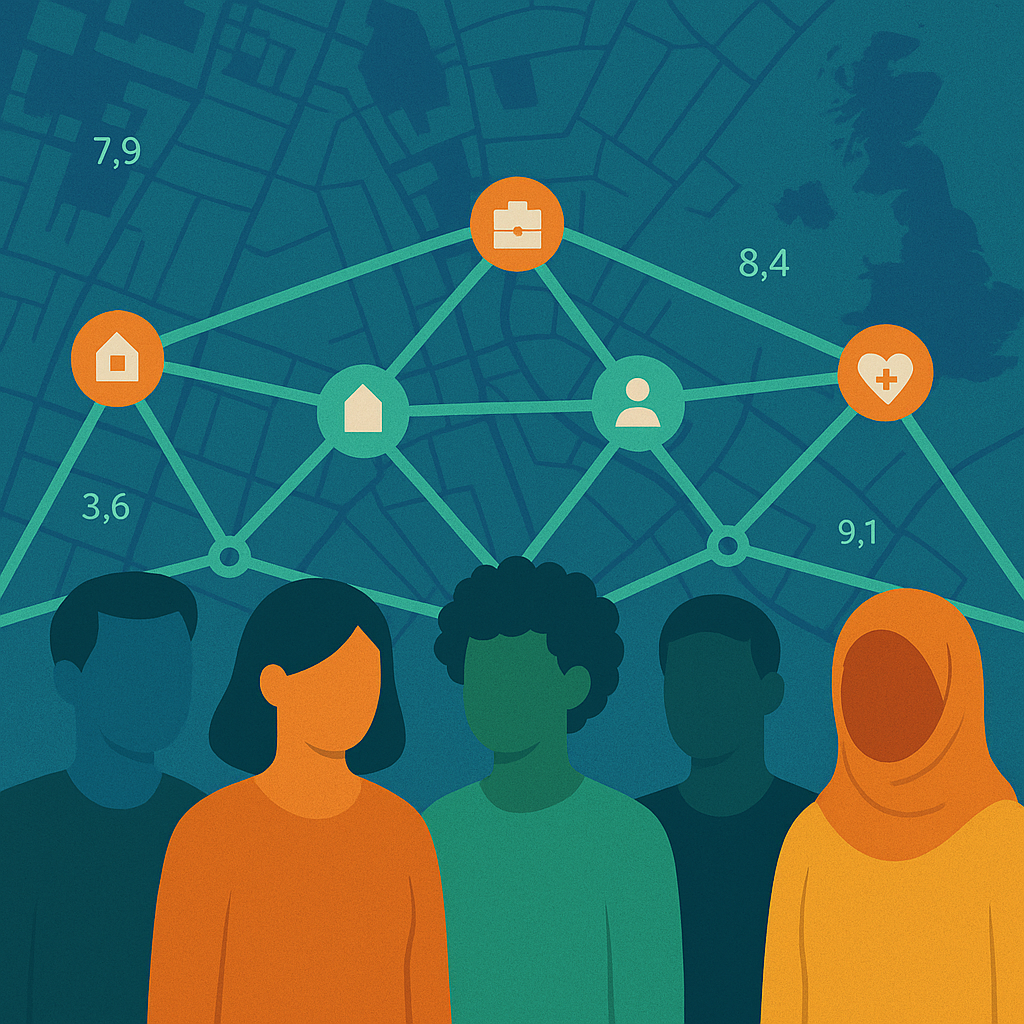
From Data to Democracy: Tackling Multiple Deprivation through Open, Community-Driven Models The publication of the latest Index of Multiple Deprivation 2025 (IMD 2025) paints a stark picture of the scale and persistence of deprivation in England, and by extension the UK. But amid the sobering data lies a clear mandate: the only path to genuine change is via democratised, open-to-all initiatives that empower communities, not simply treat symptoms. In this light, initiatives such as Angels Connect offer a vital model – one that moves beyond charity to community agency, connecting individuals to advice, resources and networks in ways that align with the systemic challenge laid bare by the data. The IMD 2025 has been published by the Ministry of Housing, Communities & Local Government and ranks 33,755 Lower-layer Super Output Areas (LSOAs) in England by levels of multiple deprivation. The seven domains captured – income, employment, education/skills & training, health & disability, crime, barriers to housing & services, and living environment show how deprivation is not simply an income problem but a cluster of intersecting risks. Some of the key findings: Among the most deprived 10% of neighbourhoods (3,375 LSOAs), 99.1% are in the most deprived decile on at least 2 domains and 67.2% on four or more domains. At local authority level, some areas show very high concentrations: for example, Middlesbrough has 50 % of its LSOAs among the most deprived 10% nationally. More than half of the LSOAs that rank among the most deprived 1% nationally in 2025 have been in that group in every published version of the IMD since 2004, signalling deep, persistent deprivation. Geographical patterns remain: the Midlands, North, coastal and post-industrial towns dominate the bottom rankings. But crucially the data also shows that deprivation is not confined to remote or rural areas, it is strongly present in urban neighbourhoods locked into multi-domain disadvantage. In sum, the data confirms what many frontline agencies observe: deprivation is structural, multi-dimensional and deeply rooted. It cannot be addressed solely through isolated interventions (e.g., only food support or only housing subsidies). The problem requires an integrated approach – one that unlocks agency, addresses root causes (employment, skills, rights), and builds resilient social systems. Given the data, policy must move beyond the “targeted safety net” model to embrace a more open, inclusive and system-wide response. Here are three imperatives: From targeted to universal access in advice and support. Areas in the poorest deciles suffer multiple burdens simultaneously – joblessness, poor health, low educational attainment, insecure housing. So limiting services only to those deemed “most in need” runs the risk of missing many who fall just outside thresholds but are still exposed to multi-domain disadvantage. Universal access to high-quality advice (on debt, welfare, employment, housing) should be considered a public good. This reflects a shift in thinking: from reactive to preventive, from crisis-management to empowerment. Local networks, digital referral and community agencyThe geography of deprivation shows persistent neighbourhood disadvantage. Policy therefore must invest in local networks that are embedded in community life, digital platforms that facilitate referral and triage of need, and training that enables neighbourhood actors (volunteers, community workers) to act as connectors. This is an inclusive model: open to all, not just those already in the system. Data-driven, but democratised decision-makingThe IMD 2025 data is vital, but the translation from insight to action must involve local voices. Data should underpin but not dictate strategy. Residents of deprived areas must have a voice in shaping how services are delivered, and how open-access platforms are configured. Moreover, the domains show that interventions must span welfare, housing, employment, health – so policy must join up across silos. Angels Connect is an exemplar of the kind of democratised, inclusive initiative policy should encourage. Rooted in the community, digital-enabled, and open to all who are navigating life-challenges, it offers a fresh blueprint, one aligned with the structural nature of deprivation the IMD 2025 reveals. Open access, not gate-kept: Rather than being confined to narrowly defined benefit recipients, Angels Connect’s model allows anyone to engage with training, advice, digital referral and community networks. This aligns with the universal-access imperative above. Referral infrastructure meets lived experience: Recognising that people living in deprived areas interact with multiple systems (housing, benefits, debt), Angels Connect offers a referral network and triage model connecting people to life-changing advice. This resonates with the IMD’s multi-domain nature of deprivation. Community capacity building & empowerment: The model does not only deliver services, it builds capability in communities, enabling volunteers and local actors to participate. This helps shift neighbourhoods from being passive recipients to active agents of change, which is critical in places where multiple domains of disadvantage are entangled and long-standing. Policy influence embedded: Angels Connect also advocates for systemic change (income security and welfare reform), not simply service delivery – which aligns with the data showing that structural disadvantage underpins the most deprived areas and that piecemeal responses will not suffice. — The IMD 2025 makes plain the challenge: entrenched deprivation, multi-domain disadvantage, and geographic concentration. Tackling this requires a paradigm shift in how we design and fund interventions: Investment in place-based digital referral networks: Government should support the scaling of open-access platforms (such as Angels Connect) across local authority areas. These networks must be interoperable, data-informed, and locally embedded. Incentivise community-led frameworks: Funding programmes should reward initiatives that enable local actors to partner in delivery, co-design solutions and build local capacity, not just contract large providers. Embed universal advice provision: Universal welfare, debt and employment advice should be considered a core public infrastructure. Just as highways or health systems are funded universally, so too should access to advice that helps people navigate complex systems and avoid spirals of multiple disadvantage. Align metrics with multidimensional outcomes: Rather than measuring in narrow silos (e.g., number of food parcels delivered), policy must measure across domains – improvements in employment, housing stability, debt resolution, mental health recovery, and community resilience. Data such as IMD 2025 should be used to map progress neighbourhood by neighbourhood.
